
Book Site Visit : 7200 141 515
Book Site Visit : 7200 141 515

Projects
Plots
Apartments
Farm Lands
Commercial
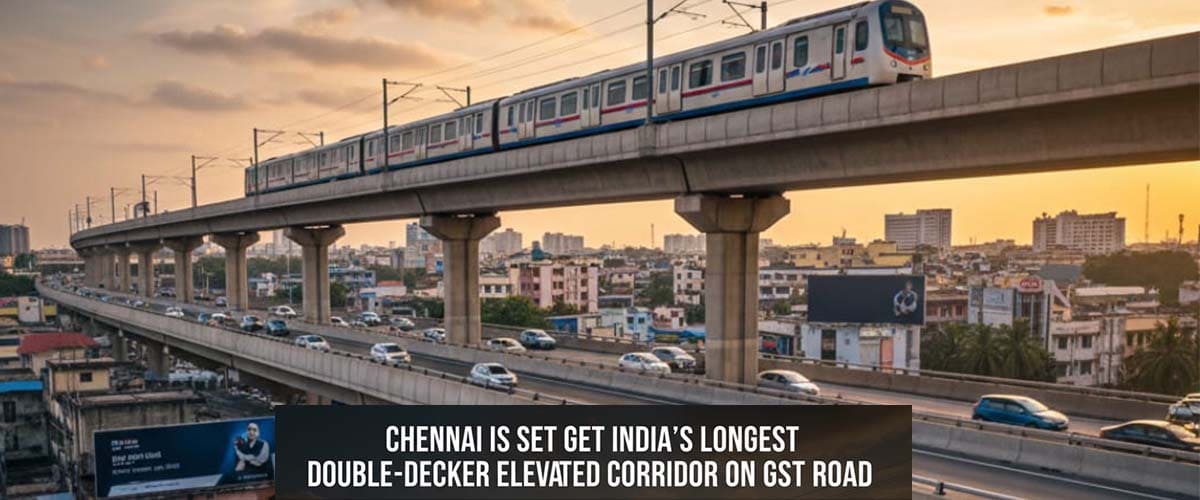
Chennai is entering a new era of urban mobility with the proposed GST Road double-decker elevated corridor—an ambitious infrastructure project that reflects the city’s forward-thinking approach to congestion, connectivity, and sustainable growth. Designed as a multi-level transport solution, this corridor is not just about easing traffic; it represents a long-term vision for how a rapidly growing metro like Chennai can move smarter, live better, and grow sustainably.
The proposed double-decker corridor is a marvel of modern engineering that reimagines how transport infrastructure can function in dense urban environments. The lower deck is planned as a six-lane elevated highway dedicated to fast-moving vehicular traffic, offering smooth, signal-free travel for daily commuters. By lifting through-traffic off the ground, the corridor is expected to significantly reduce congestion on GST Road, which has long been burdened by heavy traffic volumes, mixed vehicle movement, and frequent bottlenecks at junctions.
Above this elevated roadway sits the upper deck, a metro-ready viaduct structurally designed to support future expansion of Chennai Metro. This forward-looking design enables public transport growth without fresh land acquisition, promoting a public-transport-first model of urban planning. By stacking mobility vertically, Chennai is optimizing limited land resources—an absolute necessity along high-density corridors like GST Road.
Strategically, the corridor will connect Kilambakkam Bus Terminus to Mahindra World City, linking major residential neighborhoods with industrial zones, IT hubs, and commercial districts. This seamless connectivity is expected to dramatically reduce travel time for office commuters, improve last-mile integration with buses, metro, and suburban rail, and enhance daily travel reliability for thousands of users. As a result, this stretch of South Chennai is rapidly emerging as one of the city’s most important growth belts.
One of the corridor’s most significant achievements lies in how it directly addresses GST Road’s long-standing congestion challenges. By separating long-distance traffic from local movement and creating uninterrupted elevated travel, pressure on surface roads is reduced considerably. This not only improves traffic flow but also enhances overall road safety and driving comfort during peak hours.
One of the corridor’s most significant achievements lies in how it directly addresses GST Road’s long-standing congestion challenges. By separating long-distance traffic from local movement and creating uninterrupted elevated travel, pressure on surface roads is reduced considerably. This not only improves traffic flow but also enhances overall road safety and driving comfort during peak hours.
Beyond mobility, the project embraces sustainability and smart urban design. Encouraging metro usage helps reduce carbon emissions, while optimized land use minimizes displacement. Reduced idling time translates into lower fuel consumption, directly supporting Chennai’s long-term climate and environmental goals. The broader urban mobility vision focuses on an integrated transport ecosystem, reduced dependency on private vehicles, improved air quality, and a higher overall quality of urban life.
On a national and global scale, the project is poised to become a landmark achievement. Once completed, it is expected to be India’s longest double-decker elevated corridor and one of the longest such viaducts in the world. This positions Chennai alongside global cities that have successfully adopted multi-level transport solutions, proving that Indian metros can innovate at scale and set benchmarks for future infrastructure development.
The impact on real estate and investment is equally transformative. Infrastructure has always been a key driver of urban growth, and this corridor is no exception. Improved connectivity along GST Road is expected to lead to rising property values, increased demand for residential and commercial developments, and strong growth in plotted developments, apartments, and IT parks. For homebuyers and investors, the project signals long-term appreciation and renewed confidence in South Chennai’s peripheral markets.
Redefining Chennai’s Mobility and Urban Growth Story
With in-principle approval already in place, the GST Road double-decker elevated corridor stands as a powerful symbol of Chennai’s commitment to smart city transformation, integrated public transport, and future-ready infrastructure. More than just a traffic solution, it is a vision of how the city will move, live, and grow in the decades ahead. From congestion to connectivity and from chaos to coordination, this project is set to redefine Chennai’s mobility landscape. The future of travel in Chennai is not just ahead—it is near.
First Floor, No. 10B, Ekambaram Industrial Estate Rd, Alapakkam, Karpaga Vinayagar Colony, Valasaravakkam, Chennai, Tamil Nadu 600116


© All Rights Reserved | Website Designed & Developed By  GlintCreatives.com